






Crypto originals are the games you find under the “Originals” tab at almost every crypto casino: Crash, Plinko, Mines and Dice. We'll walk through how each game works, how big the house edge is and how the games tie into provably fair.
- What: in-house crypto games with short rounds and clear multipliers
- Best-known games: Crash, Plinko, Mines, Dice, Limbo and Keno
- House edge: around 1%, versus 4–6% on slots
- Verification: nearly all originals support provably fair
- Bonuses: the games rarely count in full toward wagering requirements
What are crypto originals?
A crypto original is a quick game the casino built itself instead of licensing from a game studio. Rounds take seconds, the house edge (the casino's built-in margin) often sits around 1%, and you can usually verify the outcome yourself afterward. Aviator, the popular plane game from the studio Spribe, often gets lumped in too, but since it comes from an external provider it's not a true original.
The name comes from the casinos' game lobbies, where these games sit under the Originals label. The hallmarks are short rounds, adjustable risk and a low house edge.
How the games came about
The games are older than most people think. As early as 2012, players were betting Bitcoin (BTC) on dice-only sites like SatoshiDice, long before today's casino platforms existed. As the platforms grew, they kept the game ideas, built them into their own lobbies and grouped them under the name originals.
The reason the house edge can sit this low is cost. A casino that licenses slots pays an ongoing fee to the game studio, usually a share of game revenue, while games built in-house cost almost nothing to run. That lets the casino get by on around 1% without the game running at a loss. That makes originals the games with the lowest house edge at crypto casinos.
Originals are still just one category among several. Slots, live casino and table games dominate the lineup of casino games at crypto casinos, and the categories differ sharply in both pace and payout rate.
How does a round in a crypto original work?
A round has four steps: you place your bet, the game derives the outcome from locked random values, the result appears instantly and you can verify it afterward. The whole thing takes less than ten seconds, faster than most slots and table games.
- You choose your stake and risk settings, such as the number of mines in Mines or the win chance in Dice.
- The game combines a server seed (the casino's secret random value) with a client seed from your browser and a nonce, a counter that increases with every round.
- That combination decides the outcome: the crash point in Crash, the ball's path in Plinko or the number in Dice.
- After the round, you can enter the values into a verifier and recalculate the result yourself.
The technology behind the random values is covered in detail in our guide to provably fair.
The games in the category: Crash, Plinko, Mines, Dice and Aviator
Five games show up at almost every casino, but they give you control in different ways. In Crash and Mines you act while the round is running. In Plinko and Dice you set everything before the outcome is revealed.
| Game | How it works | House edge | Best for |
|---|---|---|---|
| Crash | Rising multiplier, cash out before the crash | ~1% | Controlling risk in real time |
| Plinko | Ball drops through rows of pegs into a multiplier slot | ~1% | Setting the risk in advance |
| Mines | Open safe tiles and avoid the mines | ~1% | Stopping whenever you want |
| Dice | Bet over or under a number at any win chance | ~1% | Dialing in the odds exactly |
| Aviator | Crash variant from Spribe, not a true original | 3% | Watching others' bets live |
Crash
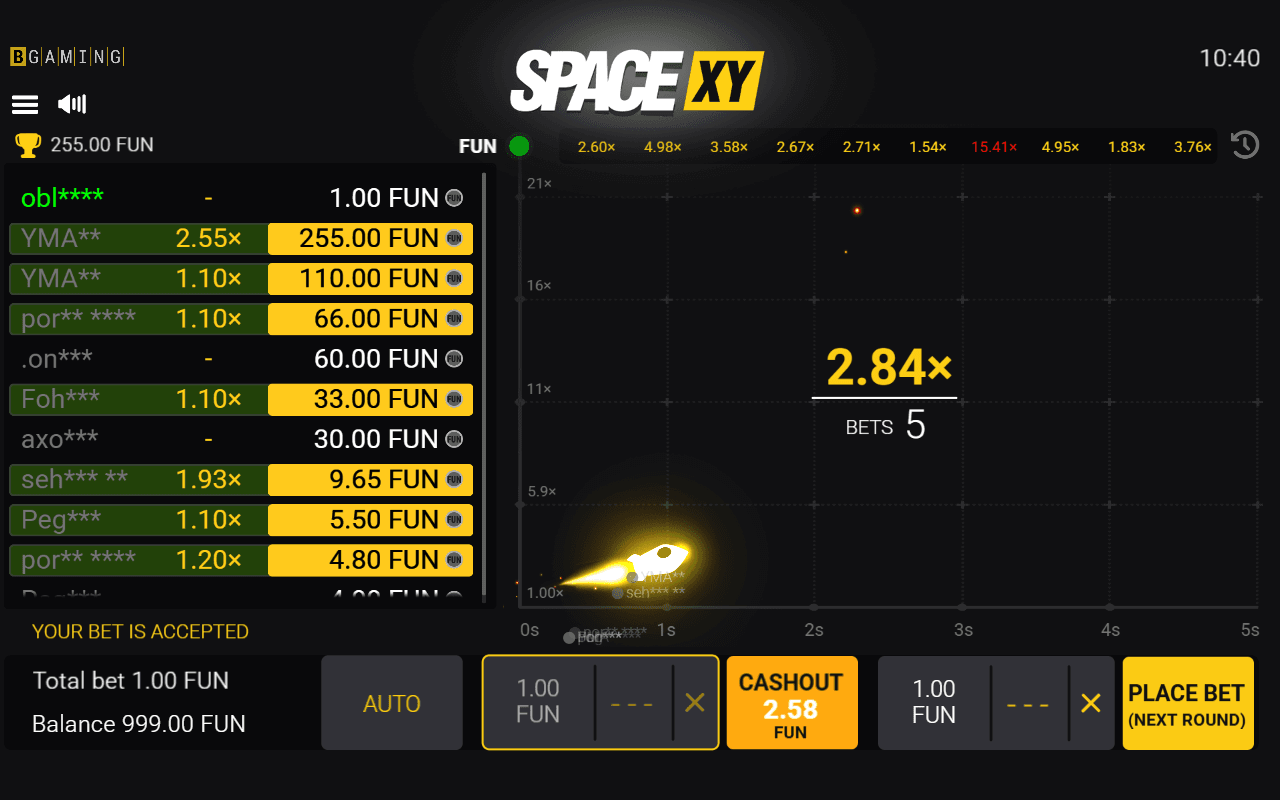
Crash shows a curve climbing from 1.00x until it breaks without warning. You win if you hit cash out before the curve breaks. Cashing out pays your stake times the current multiplier. Wait too long and the whole stake is gone, and a round can crash as early as 1.00x.
Auto cash-out lets you preset a multiplier where the game locks in the win for you. It removes the stress in the moment without improving the odds. Where the curve breaks is already set when the round starts.
Real-time control: you decide for yourself, second by second, whether to lock in the win or let the multiplier keep climbing.
Low barrier: a single mechanic to understand, and minimum bets often start at a fraction of a cent.
Fast losses: rounds lasting seconds mean your bets can tick away faster than in any other casino game.
Instant crash: some rounds crash right at 1.00x, and then it doesn't matter how quick you are.
Plinko
Plinko drops a ball over a field of pegs, and every bounce sends it randomly left or right until it lands in a slot with a multiplier. The middle slots pay little while the edges pay the most. Before each round you choose the number of rows, usually 8–16, and a risk level.
The settings decide how the wins are distributed. On low risk you win small and often. On high risk with 16 rows, the edge slots can pay up to 1,000x, while most balls land in the middle slots and return less than your stake.

Adjustable volatility: rows and risk level are set before the round, so you decide how much risk you take.
High payout rate: the casinos' own versions sit around 99% RTP, whichever risk level you choose.
Passive play: once the ball drops, there are no decisions left to make.
Rare top wins: the biggest payouts land so seldom that long winless stretches are part of the game.
Mines
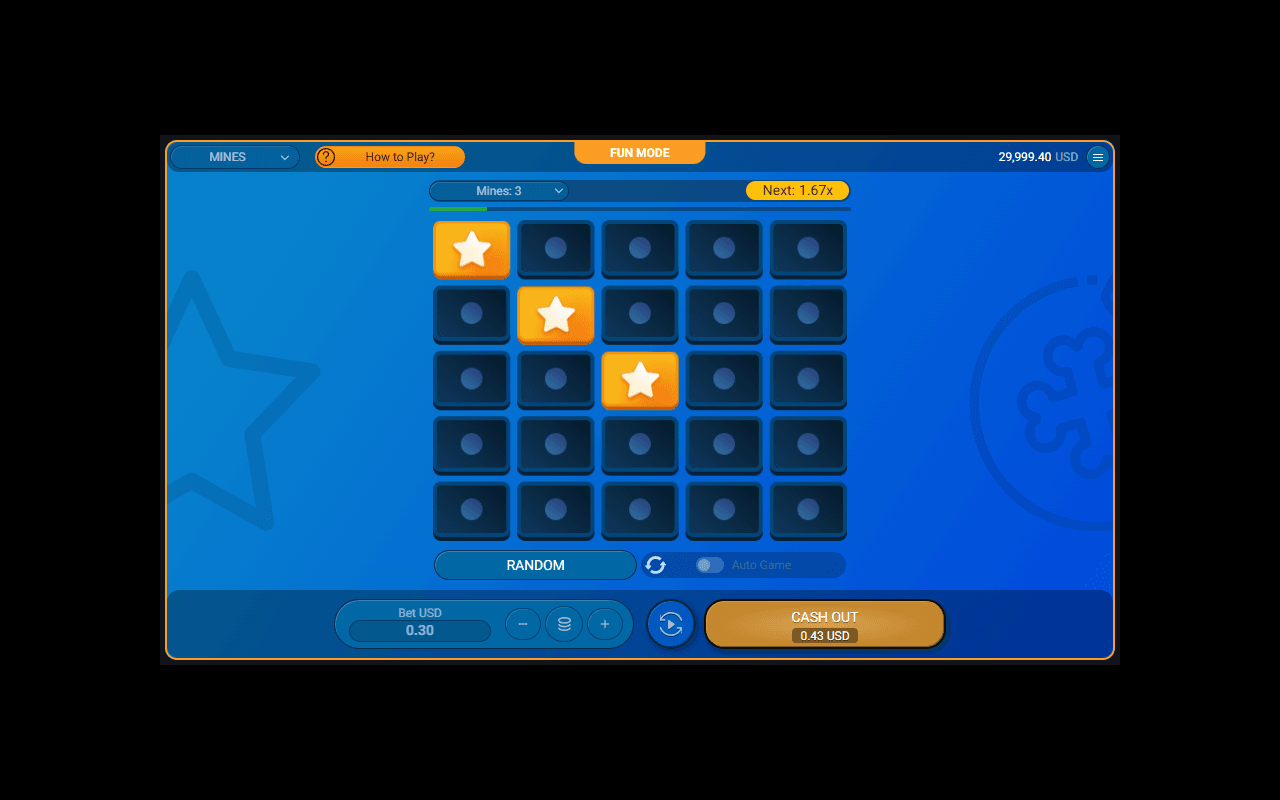
Mines is played on a grid of 25 hidden tiles, and you choose how many of them hide mines, from 1 to 24. Every safe tile you open raises the multiplier a notch, and you can end the round whenever you like and walk away with the current amount. Hit a mine and your stake is gone.
More mines mean a higher multiplier per safe tile but also higher risk. With 3 mines out of 25, the chance of surviving the first click is 88%. With 24 mines it is 4%. The setup resembles classic Minesweeper, but there are no clues here: every click is a pure gamble.
Flexible risk: the number of mines sets the entire risk profile, from cautious to extreme.
A decision at every step: after each tile you actively choose whether to end the round or keep going.
Hard to stop: every safe tile tempts you into one more click, and a single wrong one wipes the whole round.
Dice
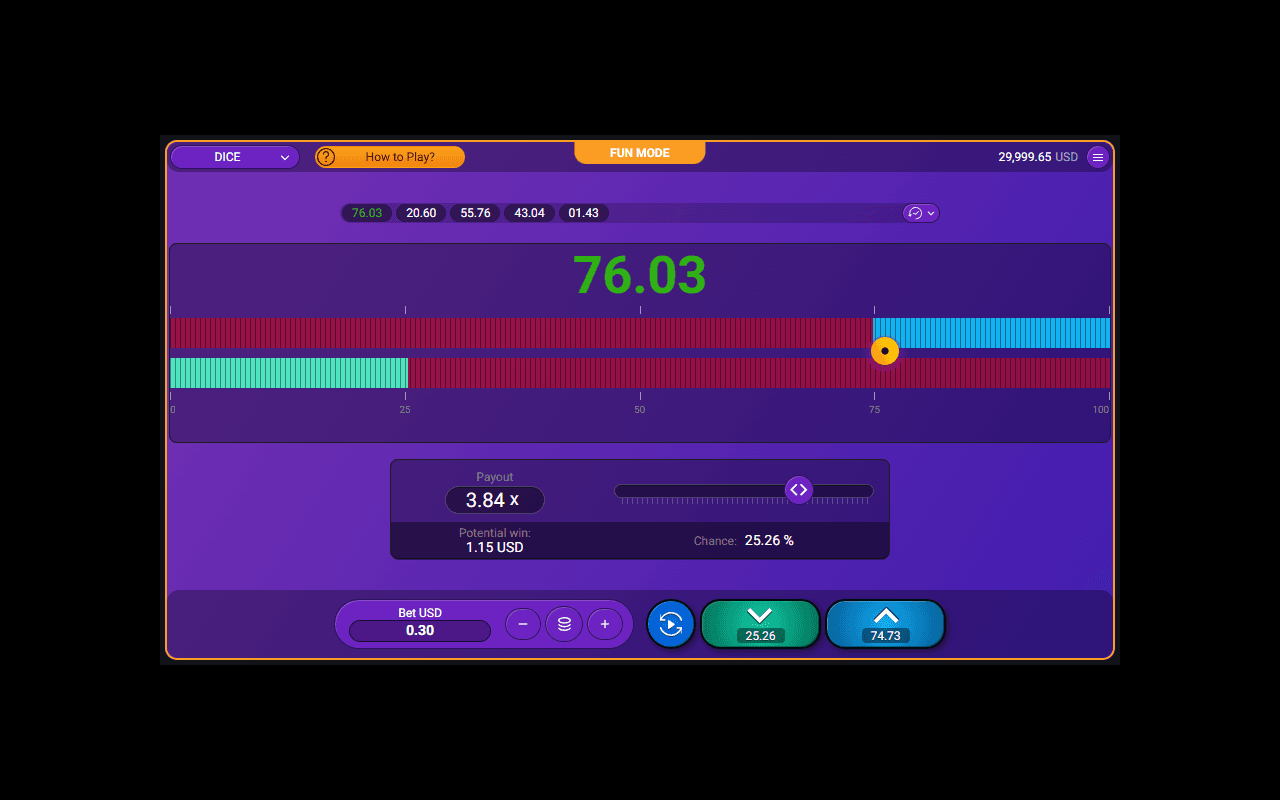
Dice lets you bet on whether a random number between 0 and 100 lands over or under a line you set yourself. The line controls both win chance and payout: a 50% chance pays about 1.98x while a 10% chance pays around 9.90x. Dice is the oldest game in the category and ran on bitcoin sites as far back as 2012.
The payout follows directly from the win chance, minus the house edge of 1%. Because the math is that simple, Dice is the go-to example for explaining provably fair. You only need the line and the random number to verify a round.
Exact risk control: the win chance is set in decimals, from long shots to near-certain small wins.
Transparent math: the payout follows directly from your chosen chance and the house edge, with no hidden tables.
Gets monotonous: with no graphics, themes or bonus features, long sessions turn repetitive.
Aviator and other studio-built crash games
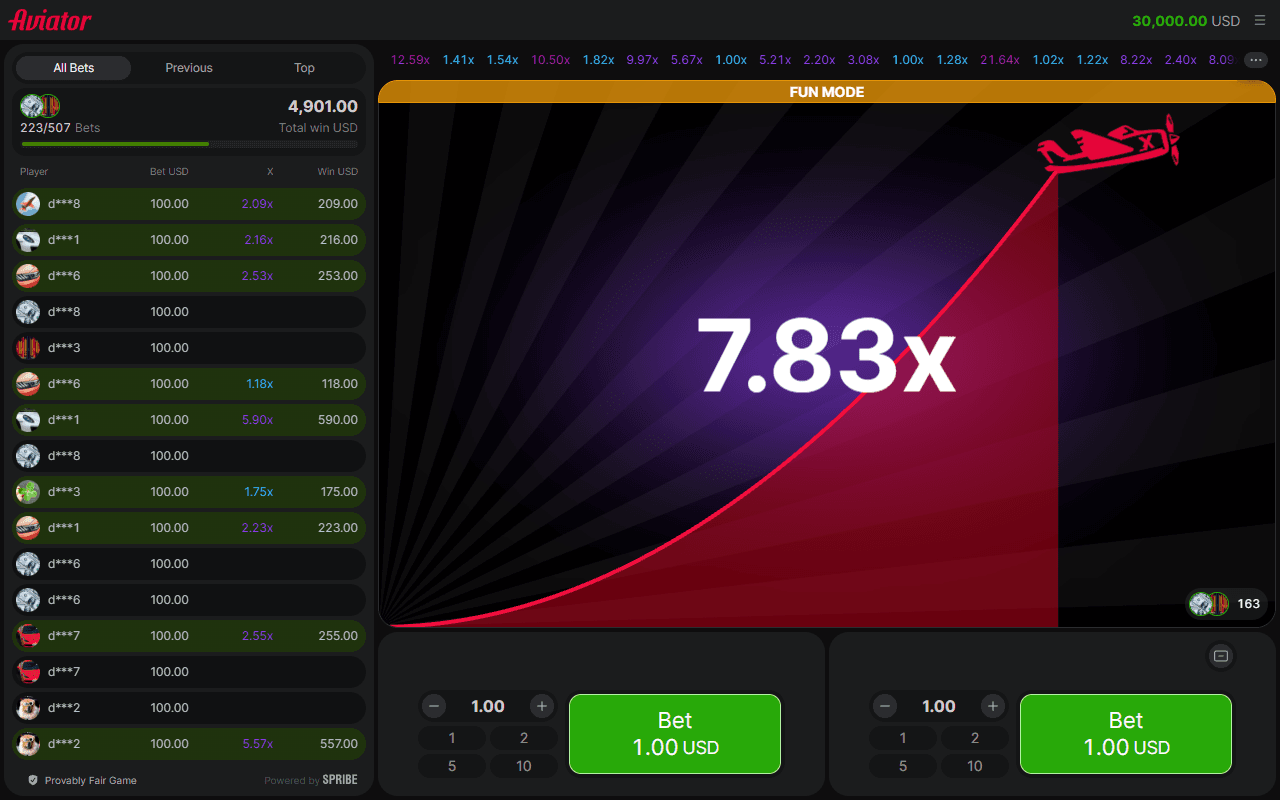
Aviator looks like an original but is a licensed game from an external studio. Spribe launched it in 2019 and licenses it out to any casino that wants it, which is why Aviator shows up on hundreds of sites at once. RTP (return to player) sits at 97% according to Spribe's own documentation. A true original is owned by the casino and exists only there.
The screen shows every player's bets and cashouts in real time. That gives the game a social feel the casinos' own originals lack. You'll find the same setup in other studio-built crash games, such as JetX from SmartSoft. The big difference from a true original is the house edge. An RTP of 97% means the house keeps 3%, roughly three times as much as in the best originals.
Other common originals
The lineup varies from casino to casino, but most offer these games:
- Limbo: you pick a target multiplier and win if the random number lands above it.
- Keno: you pick numbers, the game draws at random, and the more you match the more you win.
- Wheel: a wheel of fortune with segments in different colors and multipliers.
- Hilo: a card game where you guess whether the next card will be higher or lower than the visible one.
House edge in crypto originals: around 1%
The house edge in crypto originals usually sits around 1%. That's an RTP of roughly 99%. Slots sit at 94–96% and studio-built crash games like Aviator at 97%. Pretty much the only casino games that beat originals are blackjack and video poker played with optimal strategy.
When we opened Crypto-Games' own originals in demo mode on July 22, 2026, the numbers held up: Dice showed a 1.98 multiplier at a 50% win chance, which works out to a 99% payout rate, and Plinko's payout table on high risk with 16 rows added up to about 98.9%.
RTP is an average over millions of rounds, though, not a promise about your session. A high-risk Plinko session can end far from 99%, since nearly all the big wins sit in the edge slots and the ball rarely reaches them. A low house edge does not mean low risk. In originals, your own settings decide how much risk you take on.
No betting system can change the odds. Doubling your stake after every loss, known as the martingale method, loses you just as much in the long run as betting at random. The difference is that the losses come rarely but hit big, and when they do they often wipe out the whole bankroll.
Important: don't chase the max multipliers. Wins of 1,000x land so rarely that in practice you pay for them with long losing streaks, and the swings are biggest in exactly the game modes that advertise the highest wins.
How do crypto originals connect to provably fair?
Provably fair is the technology and crypto originals are the games that use it most. Since the casino owns the entire game code of an original, it can publish the seeds openly for every round. But it's not a hard-and-fast rule. Studio games like Aviator offer provably fair too, and there are originals that lack open verification.
To verify a round you need three values from the game history: the casino's server seed, your client seed and the round's nonce. Enter them into our provably fair calculator, which reruns the calculation locally in your browser and shows whether the casino's reported outcome holds up.
A passing result only proves the round wasn't manipulated. It says nothing about the casino's license, withdrawals or bonus terms, so vet the whole platform before depositing.
What rules apply when you play crypto originals?
The rules that apply to you depend on where you live. Gambling laws vary by jurisdiction, and casinos licensed in strictly regulated markets often cannot accept cryptocurrency at all. That is why you find originals almost exclusively at offshore-licensed operators.
Winnings may be taxable. Gambling tax rules vary by country and by your tax residency, and converting crypto winnings to fiat or another crypto can be a separate taxable event. Our guide to tax on winnings covers the basics, and your local tax authority has the final word.
The protection you get as a player comes from the casino's license, not from the game you play. Offshore regulators rarely require deposit limits, and national self-exclusion schemes generally do not cover these casinos. Different casino licenses hold operators to very different standards.
How do you choose the right crypto originals game?
Pick a game based on how much control you want. In Mines you decide tile by tile and in Crash you react in real time, while Dice, Plinko and Limbo come down to the settings you choose before the outcome appears. Then work through house edge, verification and terms.
- Compare the house edge per title: the same game idea can carry different margins at different casinos, and the gap between 1% and 3% adds up over time.
- Check the verification: look for seeds and a verification tool in the game history before betting real money, and rotate your client seed every so often.
- Read the bonus terms: originals are often excluded from wagering requirements or contribute just a few percent, so an active bonus can lock up your withdrawals.
- Vet the casino behind the games: license, reputation and withdrawal history matter more than the game selection, and our rundown of how safe crypto casinos are lists the checkpoints.
- Set your budget before the first round: pick a cap you can afford to lose, stick to it and treat the games as entertainment that costs money. You'll find more tools in our guide to responsible gambling.
Tip: most originals can be tried in demo mode or with minimum bets at a fraction of a cent. Set the same risk levels you plan to play with for real and get a feel for the variance before real money is on the line.
Online gambling laws vary by jurisdiction. The legality of using crypto casinos depends on where you live. Check your local rules before signing up. Gambling involves risk. Play responsibly. 18+.