





A VPN can change which crypto casinos load for you, but using one near a geoblock is rarely as simple as flipping a switch. The technology shifts your apparent location and adds a layer of encryption. Operator terms, license conditions, and detection methods do not move with it. This guide explains how VPNs work, why crypto casinos geoblock players, and what actually happens if you play through one.
How does a VPN work?
A VPN (Virtual Private Network) is a service that routes your internet traffic through a remote server before it reaches the rest of the web. The server encrypts that traffic, and because VPN providers run servers in dozens of countries, you can choose which country your connection appears to come from.
A VPN can be used to watch geoblocked TV streams or to reach a casino site that blocks your country. The technology is the same, only the destination differs.
Encrypted traffic adds a privacy layer
One practical benefit is encryption. On a public network like a hotel or cafe Wi-Fi, the VPN tunnel keeps your traffic from being readable by other users on that network or, in normal cases, by your internet provider. That is the everyday reason most people install a VPN, well before any casino question.
A different IP address shifts your apparent location
The other effect is that your IP address is replaced by the VPN server's IP. To the website you visit, you appear to be browsing from wherever that server sits. That is what enables VPN users to reach geoblocked content, including streaming services, news sites, and crypto casinos that restrict players from certain countries.
Tip: Anonymous play without KYC at Crypto-Games

- Costa Rica registration (no KYC required)
- Up to 20,000 USDT welcome bonus
- 10% rakeback every week
- Deposits and withdrawals in 13+ cryptocurrencies
VPNs and geoblocking on crypto casinos
Casinos have to follow the license conditions of the jurisdiction they are licensed in. Depending on the license, different restrictions apply, from how the casino can market itself to which countries its players are allowed to be from.
That usually shows up as a positive list (countries where players are accepted) or a negative list (countries where they are not). To enforce it, operators rely on geoblocking and other location checks at the website level.
Geoblocking is also tightening over time. Several regulators are moving toward standards where the mere fact that a local player can reach a site brings the operator under that country's gambling law. The practical effect is that more operators actively block traffic from those jurisdictions rather than risk regulatory action.
When a player from a blocked country opens the casino, the homepage may load a notice instead of the lobby. The example image below from Betpanda shows what that looks like for a player whose country is excluded. As the message itself notes, one workaround players try is a VPN.
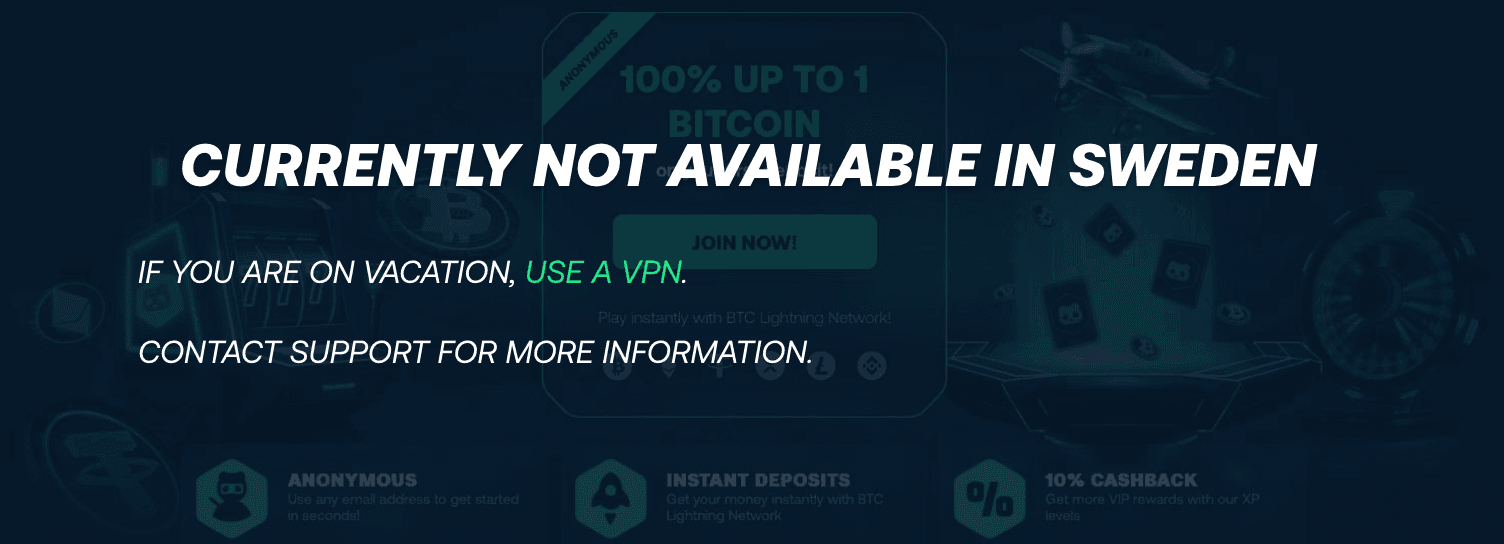
(Image source: Betpanda.io)
Connecting through a country the casino accepts
When you turn a VPN on, you choose which country your connection appears to come from. If the casino blocks your country but accepts players from, say, Canada, picking a Canadian server is what makes the lobby load. The traffic still originates from your device, but the casino sees the VPN server's IP first.
VPNs can also unlock more games
Geoblocking is not only about which country you live in. Game studios apply their own license conditions, and some slots and table games are blocked in countries the studio cannot legally serve. The casino itself may be available to you, but specific titles in the lobby will not load.
In practice, the same casino can present a different game catalog depending on where the connection appears to come from. If you play from France, for example, slots from certain providers may be blocked, while connecting through a VPN server in Portugal opens up the full library. A VPN can change which titles are accessible, not just which casinos are.
What is a VPN-friendly casino?
When a crypto casino describes itself as “VPN-friendly,” it means the operator does not actively block traffic that arrives via known VPN endpoints. Detection at that level is technically possible, and many regulated brands do block VPNs. Crypto-native operators tend not to, and examples in our crypto casino list include Rakebit, Crypto-Games, and Jackbit. VPN-friendly does not mean risk-free, and the next section covers the risks that survive even on those sites.
Risks you should know about
Playing on a casino through a VPN carries a set of risks that are mostly contractual rather than technical. The casino's terms of service are what define whether your account is at risk, and “your country” is usually the country listed on your ID, not the country your VPN is set to.
You may be breaching the casino's terms
If the terms of service exclude players from your country, creating an account through a VPN puts you in breach from the start. The casino may not flag it during registration. Deposits and play may proceed normally for a while.
The pinch point is usually KYC at withdrawal. When the casino asks for ID, your real country becomes apparent, and the operator can apply its terms: account closure, frozen funds, voided bonuses, or in some cases voided winnings. From the casino's side, this is enforcement of conditions you accepted at signup, not retroactive punishment.
A casino can detect your real location through other signals
It is common to assume that a VPN fully hides your nationality, and that as long as the server is in an accepted country the operator has no way to know otherwise. That is not how detection works in practice.
Operators that take geoblocking seriously look at signals beyond IP address. Payment cards repeatedly issued by banks in one country, browser language and timezone, device fingerprint patterns, the address attached to a crypto wallet, and historical behavior all feed into a single picture. A VPN moves the IP. It does not move any of the rest.
There are also technical ways VPN traffic can be unmasked that are worth knowing about:
- WebRTC leaks - A browser feature for video calls can in some cases reveal your real IP address even when a VPN is active.
- DNS leaks - If DNS traffic escapes the VPN tunnel, your real internet provider is visible, which usually reveals the country.
- Browser fingerprinting - Fonts, screen resolution, graphics card, and similar details build a unique device signature that links sessions across IP changes.
- ASN detection - IP addresses from well-known VPN providers can be flagged as datacenter traffic and separated from regular home connections.
- Timezone and language - A browser language and timezone that do not match the country of the IP address is an obvious red flag.
How strictly this is applied varies. VPN-friendly casinos generally ignore these signals, while strictly geoblocked operators can freeze an account immediately. For larger withdrawals, a manual review often weighs several signals together.
Self-exclusion registers do not cover offshore crypto casinos
National self-exclusion registers only apply to operators licensed in the country that runs them. GAMSTOP covers UK-licensed sites, Spelpaus covers Sweden, ROFUS covers Denmark, Spillesperren covers Norway. None of these extend to offshore crypto casinos. A player who has self-excluded at home can still reach a crypto casino through a VPN, and no national warning system will intervene. If you registered for an exclusion for a reason, the reason has not changed because the casino sits outside the register. Our responsible gambling guide covers what to do if you find yourself in that position.
Legal context
Online gambling laws vary by jurisdiction. Whether using a VPN to access a crypto casino is itself legal in your country, and whether the casino can serve you regardless of how you reach it, are separate questions with different answers in different places. Before signing up, check the rules that apply where you actually live, not where your VPN points. Gambling involves risk. Play responsibly. 18+.
Checklist before playing with a VPN
- Choose a VPN-friendly casino. On a VPN-friendly site, the connection itself is unlikely to trigger an account freeze. The terms of service still apply, so this only removes one of the risks.
- Read the casino's country rules. Open the terms and search for your country by name to see if it is on a positive or negative list. On crypto casinos, restrictions usually appear as a list of excluded countries rather than an explicit list of accepted ones.
- Expect ID verification. Play only on sites where you are willing to upload ID later. Even on a so-called no KYC crypto casino, checks can be triggered by large withdrawals or unusual transaction patterns.
- You may have limited consumer protection. If the casino is not licensed in your country, the local consumer-protection regime usually does not apply. Disputes with the operator have to be raised inside whatever framework the operator's own license offers, which is one of the broader risks of crypto casinos.