



How KYC works at a crypto casino depends entirely on where the operator holds its license. Licensed casinos in regulated markets always run full KYC checks before you can play. Many crypto casinos do not, or they only ask for ID documents in narrow situations. The legal reasoning behind that difference comes down to which jurisdiction the casino is licensed under.
What KYC means and why it exists
KYC stands for Know Your Customer. It refers to the rules that require regulated companies to verify who their customers are before letting them transact. KYC also covers ongoing transaction monitoring, so that customer activity stays consistent with the stated purpose of the account.
Customer-due-diligence rules exist to reduce the risk of anonymous transactions, money laundering, and terrorist financing. They also keep minors out of regulated gambling. KYC is usually broken down into four areas:
- Identity: confirming personal details and minimum age (18+)
- Risk: assessing transaction risk based on the customer profile, amounts, and transfer history
- PEP: checking whether the customer holds a politically exposed position
- Monitoring: detecting and reporting suspicious transactions
Regulated firms must have sound knowledge of their customers and the nature of their business in order to prevent the operation from being exploited for money laundering or terrorist financing. The principle is set out in the FATF Recommendations adopted by jurisdictions worldwide.
A KYC process typically runs in two stages. The operator confirms the identity of the customer, then establishes the purpose for using the service.
How identity verification works
At most international casinos verification means uploading a copy of a government-issued ID (passport, national ID card, or driver's license). You will usually need a second document confirming your address, such as a utility bill or bank statement. Some markets, like Sweden and Norway, layer national e-ID systems on top of this for licensed local operators, but those flows do not apply on global crypto casinos.
Depending on the operator, you may also be asked questions about your personal finances and whether you qualify as a politically exposed person (PEP) under the FATF Recommendations.
Why a casino asks about your purpose
On top of identity documents, an operator may ask why you are opening the account. With a brokerage that question covers expected investment amounts and trading frequency. With a casino the answer is obvious: gambling for real money. National regulators may still require operators to set deposit and session limits as part of responsible gambling. That is a separate framework from KYC.
What follows is how casinos actually work with and without KYC, and where they differ in practice and in law.
Casino with KYC: how licensed casinos operate
A licensed casino verifies your identity before you can deposit or wager. The exact steps depend on the licensing jurisdiction, but the principle is the same: ID up front, no play before verification. Casinos with a Malta Gaming Authority or UK Gambling Commission license run some of the strictest checks in the industry.
- Holds a gambling license (MGA, UKGC, or similar)
- Payments almost always in fiat currency
- KYC required at registration
- Follows the laws of the licensing country
- Tax treatment of winnings depends on your jurisdiction*
*Gambling tax rules vary by country and by your tax residency. Check your local rules.
Licensing frameworks and regulator requirements
A casino is bound by the rules of the country where it is licensed. European regulators such as the Malta Gaming Authority and the UK Gambling Commission impose detailed rules on KYC, player protection, and anti-money-laundering controls. Crypto-friendly jurisdictions sit on the other end of the spectrum: the Curaçao Gaming Authority issues licenses under the LOK (the National Ordinance on Games of Chance, in force since December 2024), and Anjouan Gaming is a separate offshore framework that explicitly permits cryptocurrency transactions.
If a licensed casino does not meet its regulator's KYC obligations, the regulator can issue warnings, financial penalties, or revoke the license. European regulators have repeatedly fined major operators for inadequate customer due diligence.
Geographic restrictions and self-exclusion
Thorough KYC at registration lets the operator confirm that players come from accepted countries. It also lets them check ages and, in some jurisdictions, cross-reference national self-exclusion registers. Examples include GAMSTOP in the United Kingdom, Spelpaus in Sweden, ROFUS in Denmark, and Spillesperren in Norway. These registers only apply to operators licensed in those specific countries. Crypto casinos with offshore licenses are not connected to them.
Step by step: registering at a licensed casino
- Open the account: enter your name, email, and contact details. Some operators add phone verification.
- KYC at registration: upload an ID document and proof of address. Until verification clears, you cannot deposit or wager. Some operators also ask about expected play limits up front.
- Deposit: fund the account in fiat (card, bank transfer) or in crypto, depending on what the casino accepts. Operators that take cryptocurrency are usually licensed outside the European Union.
Casino without KYC: how crypto casinos work
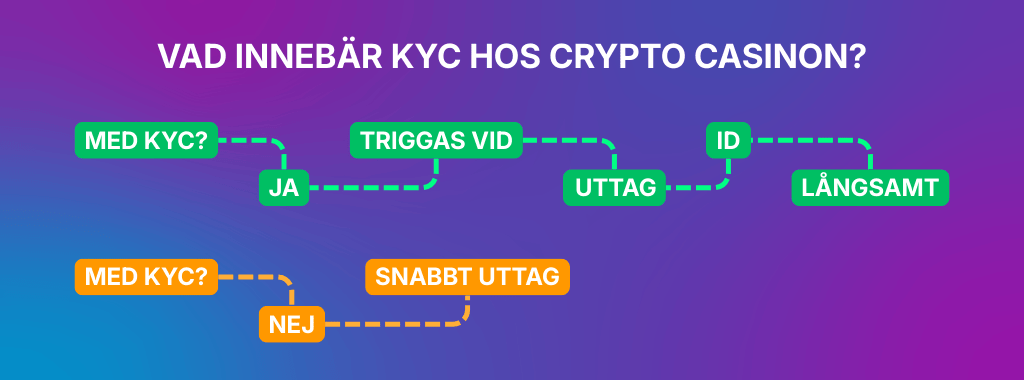
In the crypto casino space a sizeable share of operators either do not require KYC at all or only request it in narrow scenarios. Verification might only kick in for large withdrawals or for accounts flagged as suspicious. The pattern is consistent:
- License from a country with light-touch regulation
- Crypto payments instead of fiat
- KYC only triggered in specific situations
- Sits outside the strictest national regulatory frameworks
Tip: play anonymously without KYC at Crypto-Games

- Costa Rica registration (no KYC required)
- Welcome bonus up to 20,000 USDT
- 10% rakeback every week
- Deposits and withdrawals in 13+ cryptocurrencies
Light-touch regulation: why not every crypto casino requires KYC
The reason KYC is missing, or only triggered in narrow cases, is that many of these operators hold licenses in jurisdictions with limited gambling-specific rules. The two most common are Curaçao and Anjouan.
Examples of crypto casinos licensed by Anjouan Gaming:
Examples of crypto casinos with a Curaçao license:
Because the operator follows the laws of its licensing country, the requirements imposed on players can be far lighter than what European-licensed casinos demand.
The legal workaround: how no-KYC casinos protect themselves
The terms and conditions of a no-KYC crypto casino typically state that only players from specific countries may register and play. The operator uses that wording to argue that it does not target, for example, the US or the European market, and is therefore not bound by their rules.
Some operators also apply geo-blocks that prevent access from restricted countries unless the player connects through a VPN.
In practice, because the operator does not run KYC at signup, players from anywhere in the world can create an account, send crypto, and play. The terms exist primarily to give the operator legal cover.
Step by step: how to play at a no-KYC crypto casino
- Open the account: all you need is an email address, or you can connect a crypto wallet such as MetaMask.
- Deposit: fund the account in cryptocurrency. Bitcoin is universally accepted, and Ethereum and stablecoins like USDT and USDC are common alternatives.
- KYC (sometimes): whether and when an operator demands KYC depends on its license, its level of decentralization, and the amounts in play. Even casinos that market themselves as “no KYC” can request documents later. Just not at signup.
Decentralized casinos: 100% anonymous play
Decentralized casinos are platforms that run gameplay fully or partially on a blockchain. The fully decentralized variants are built from smart contracts on-chain and do not need a license to operate or to use.
Online gambling laws vary by jurisdiction. The legality of using crypto casinos depends on where you live. Check your local rules before signing up. Gambling involves risk. Play responsibly. 18+.