




Every blockchain handles speed, fees, and smart contract support differently. So the best chain for crypto casino play depends on how you play and what you prioritize.
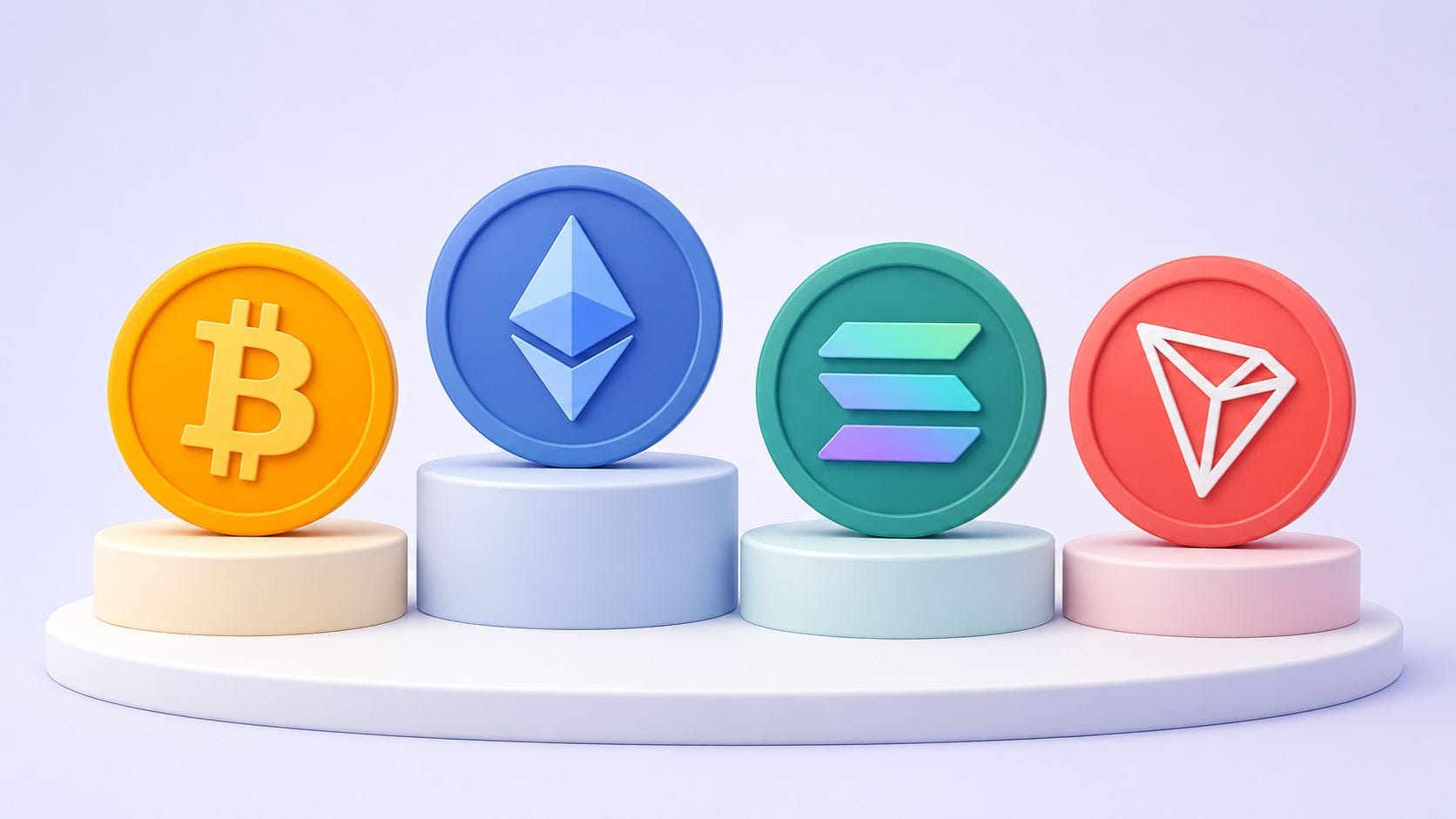
There is no single best blockchain. The right choice depends on how you play. Bitcoin works best for wide acceptance and large deposits, Solana for the fastest and cheapest transactions, TRON for USDT payments thanks to the broadest support, and Ethereum for smart contracts and decentralized Web3 casinos (where you play through your own wallet). If you want to avoid price swings, pick a stablecoin like USDT or USDC on a cheap network.
- Cheapest per transaction: Solana (a fraction of a cent)
- Widest casino acceptance: Bitcoin
- Most common for USDT: TRON (TRC-20)
- Most features and tokens: Ethereum and EVM chains
- Avoid price swings: USDT or USDC on a cheap network
What is the difference between a blockchain and a cryptocurrency?
A blockchain is the network and infrastructure that processes and secures transactions. A cryptocurrency is an asset that lives on a blockchain. A single chain can handle many currencies and tokens: on Ethereum, transactions run with hundreds of different ERC-20 tokens. This guide focuses on the properties of the chains, not on individual currencies.
If you would rather understand the difference between specific cryptocurrencies, see our guide on how to choose the right cryptocurrency for a crypto casino.
Always check both the currency and the network before you deposit. USDT on TRON, USDT on Ethereum, and USDT on BNB Chain are the same token but three different deposits. Pick the wrong network and your funds can get stuck or, in the worst case, be lost.
Which blockchain suits which player?
Your playing style matters more than the casino's lineup, since most established crypto casinos support all four major chains. If you make a few large deposits, you will barely notice the fee difference and can choose based on acceptance. If you play often in small amounts, you benefit from low fees and fast confirmation. The table below shows what each chain is best for and how widespread support is across casinos.
| Blockchain | Best for | Casino acceptance |
|---|---|---|
| Bitcoin (BTC) | Wide acceptance, large deposits | Very high |
| Ethereum (ETH) | Smart contracts, Web3, ERC-20 | High |
| Solana (SOL) | Fast, small transactions | Medium |
| TRON (TRC-20) | USDT payments | Medium to high for USDT |
| EVM chains (Polygon, BNB Chain) | Flexibility, lower fees | Varies |
Across the crypto casinos we compare, Bitcoin is accepted by 26 casinos, Ethereum by 26, USDT by 26, and Solana by 22 (updated October 2026). Acceptance of the chain itself is rarely the problem. In practice, the choice more often comes down to fees and speed. Note that a casino list shows which currency is accepted, not which network: the network used for USDT, for example, varies and must be checked per casino.
Which blockchain has the lowest fees for casino play?
Solana has the lowest transaction cost of the common networks, usually a fraction of a cent. TRON can be almost free if you have staked TRX, but a USDT transfer without staked resources costs around $1 to $4 in practice. Bitcoin and Ethereum are the most expensive on their main networks, while Layer 2 and stablecoins on fast chains bring the cost down.
Current fees and speeds per network

Native fee
Token fee
Native fee
Token fee


Native fee
Token feeERC-20

Native fee
Token fee

Native fee
Token feeSPL

Native fee
Token feeTRC-20
Fees refresh every 30 minutes. EVM networks reflect gas price at sync time; Bitcoin and Litecoin show a 24-hour average. Rollup values (Arbitrum, Base, Optimism) include an L1 inclusion-cost estimate and can vary with Ethereum mainnet load.
The figures above update continuously. For large deposits, it matters little whether the fee is a cent or a dollar. For small, frequent transactions, prioritize a low fee, for example through Solana or TRON. Ethereum's Layer 2 solutions cut the fee sharply compared with mainnet.
When is Bitcoin the best fit at a crypto casino?
Bitcoin is the best fit when you prioritize wide acceptance and large deposits. Almost every crypto casino supports BTC, and the network is considered the most secure. The downside is speed and fees: a block takes around 10 minutes and the cost runs higher than on Solana or TRON. In practice, Bitcoin's blockchain handles only the Bitcoin cryptocurrency.
Acceptance: Almost every crypto casino supports Bitcoin, so you can make deposits and withdrawals on most sites. Compare options in our guide to casinos that accept Bitcoin.
Security: Bitcoin is considered the most secure blockchain, thanks to high decentralization and a long track record with no unplanned outages since 2013.
Slow: A block is created roughly every ten minutes, and under heavy load a confirmation can take longer. Lightning Network makes BTC fast and cheap where it is supported.
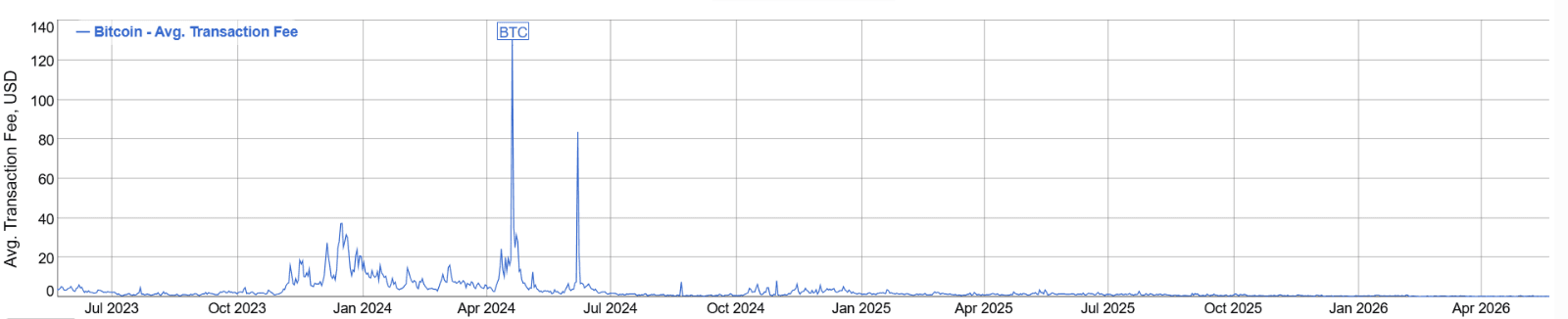
Fee: The transaction cost is higher than on most other chains. In 2026 it is usually under $1, but it can climb to around $30 or more during heavy network congestion (see the chart below).
When is Ethereum the best fit at a crypto casino?
Ethereum is the best fit when you want to play with smart contracts, many different tokens, or at Web3 casinos. The chain supports ERC-20 tokens, NFTs, and game mechanics that can be verified on the blockchain. For ordinary deposits, Ethereum is not always the cheapest, since the fee on mainnet can run high.
A Web3 casino is a decentralized casino where you play through your own wallet and smart contracts handle the payouts, unlike an ordinary crypto casino that simply accepts crypto as payment. The same wallet address also works on EVM-compatible chains.
Many tokens and Web3: If you want to play with several different tokens, NFTs, or at decentralized casinos, Ethereum is often the best choice. The wallet address you use on Ethereum also works on EVM-compatible blockchains.
Provably fair: Casinos on Ethereum and other smart contract chains can offer provably fair, which makes a game's outcome verifiable after the fact. That makes the result checkable, but it does not by itself guarantee that the whole casino is trustworthy.
Transaction fee: The fee on Ethereum's mainnet has at times been high. In 2026 a simple transfer usually costs under $1, but it can climb to several dollars during congestion. For microtransactions, Layer 2 solutions are often better.
Variable cost: How high the fee gets depends on the transaction type. More complex transactions can cost considerably more than a simple transfer.
When are EVM chains like Polygon, BNB Chain, and Avalanche the best fit?
EVM chains are the best fit when you want the same address format across several networks and access to many tokens. EVM stands for Ethereum Virtual Machine, and these chains are compatible with Ethereum in various ways. They use the same address format (0x format) and sign transactions in a similar way, but handle the cryptocurrencies separately. They fall into two groups.
Layer 2 solutions
Layer 2 solutions are built on top of Ethereum. They use Ethereum's address and security but can reach faster and cheaper transactions. Examples are Optimism and Arbitrum.
Separate EVM chains
Separate EVM chains have their own technology and their own validation process and are technically not linked to Ethereum. The wallet address, though, is built in the same 0x format as Ethereum. Examples are Avalanche and BNB Chain.
Same address: For security, it is wise to play from a separate wallet, not your main wallet. EVM-compatible chains let you manage cryptocurrencies and tokens across several chains while tracking everything through the same address format and explorer, for example Etherscan.
Same functionality: Most EVM chains share technical solutions, so it is easy to move between chains and still understand how the features work.
When is Solana the best fit at a crypto casino?
Solana is the best fit for fast, small transactions where cost and speed matter most. The chain launched in 2020 with a focus on scalability and has a block time of around 0.4 seconds, compared with Ethereum's roughly 12 seconds. That makes deposits and withdrawals fast, provided the casino supports Solana. If you want to play with SOL or stablecoins on Solana, compare Solana casinos and check which currencies and networks are accepted.
Speed and fees: Solana's biggest advantage is speed and low cost, which suits microtransactions. When you need speed, such as live betting, Solana is one of the best options.
Casino support: Many casinos support deposits and withdrawals in Solana, both because SOL is one of the largest cryptocurrencies and because players appreciate the blockchain.
Fewer validator nodes: Solana has considerably fewer validator nodes than Ethereum, which critics point to as a weakness for decentralization.
Technical outages: Solana has had downtime. The most serious lasted around 19 hours on February 25, 2023, and a shorter outage of around 5 hours occurred in February 2024. Since then, the network has had no full outage.
When is TRON (TRC-20) the best fit at a crypto casino?
TRON is the best fit for low-fee USDT payments. The network launched in 2018 and has become the most common choice for stablecoin transfers in gambling, above all USDT via TRC-20. That makes TRON practical for deposits and withdrawals where low cost outweighs advanced Web3 features. If you want to play with Tether, compare USDT casinos and check whether the casino supports TRC-20.
Broadest support for USDT: With its focus on payments and stablecoins, TRON has become an obvious network in gambling. It is very common for casinos to accept USDT via TRC-20.
Fast and cheap with staked TRX: TRON uses an energy and bandwidth model. With staked TRX, a transfer can be almost free, which suits small, frequent deposits.
Fee without staked resources: Without staked TRX, TRX is burned for energy, and a regular USDT transfer then usually costs around $1 to $4 (as of 2026). Do not count on almost free unless you have staked resources.
Weaker decentralization: TRON is validated by 27 Super Representatives, which is few compared with the thousands of validators on Ethereum. That has drawn recurring criticism.
Less innovation: TRON focuses on payments rather than complex dApps and DeFi. That does not affect the gameplay, but it offers fewer advanced game options than Ethereum.
When is Dogecoin the best fit at a crypto casino?
Dogecoin is the best fit for smaller deposits where a low fee outweighs wide acceptance, smart contracts, or stablecoins. It launched in 2013, has a block time of around one minute, and often lower fees than Bitcoin. Dogecoin started as a memecoin and is still used as a tipping currency in online communities. If you want to use DOGE, compare Dogecoin casinos and check that both deposits and withdrawals are supported.
Common for small transactions: With low fees and relatively fast blocks, Dogecoin is often used for micropayments.
Established in the community: Dogecoin is widely used on platforms like Reddit and Discord, through bots that send DOGE between users on top of the chain.
Dogecoin only: Dogecoin is its own chain that is not compatible with others, so only the Dogecoin cryptocurrency can be used. Most people who play at a crypto casino want to handle more cryptocurrencies.
How do you check that the casino supports the right network?
Check the network in the casino's deposit section before you send anything. Pick exactly the same network in your wallet or exchange as the casino specifies, and start with a small test deposit. The wrong network is the most common reason crypto deposits get stuck or are lost, since the same currency can exist on several networks.
- Currency: BTC, ETH, USDT, USDC, SOL, or TRX should match what the casino lists.
- Network: ERC-20, TRC-20, BEP-20, Solana, or Polygon should be exactly the same in your wallet as in the casino's deposit address.
- Withdrawal network: check that the casino pays out on a network you can receive.
- Minimum deposit: some casinos have a minimum per currency.
- KYC on withdrawal: check whether KYC may be required before you deposit.
- Wallet or exchange fees: your sender can charge a separate fee on top of the network fee.
Always send a small test deposit first. It is a simple safeguard to avoid bigger losses from scams or the wrong network.